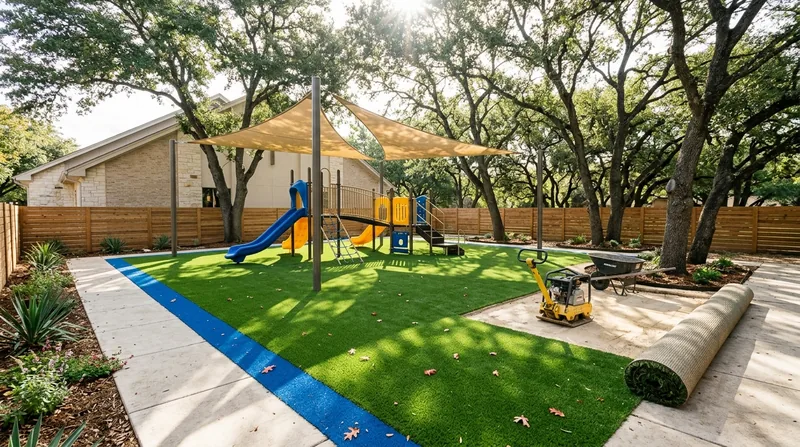




Playground and school turf in Round Rock replaces worn mulch, pea gravel, and bare dirt under climbing structures, swings, and slides with a durable, cleanable surface that drains fast after the flash-flood storms that sweep down from the Hill Country. Round Rock schools, daycares, churches, and HOA parks sit across three zip codes and two terrain zones: limestone bedrock and cedar-heavy West Round Rock, blackland clay and forest edge to the east, and tech corridors along the interstate where outdoor play space is squeezed between buildings. Playground turf stays cleaner than organic mulch after a storm, eliminates splinter hazards, and requires no seasonal replacement or raking. We size padding to the fall height of your equipment, schedule work around occupied campuses, and deliver a surface that holds up to 100-degree summers and cedar pollen winters.
Why Playground Turf Matters in Round Rock Schools and Parks
Round Rock's climate and soil create a perfect storm for mulch failure. Intense summer heat dries organic mulch to powder, heavy spring storms wash it away or compact it into a dense mat, and cedar pollen embeds itself in every fiber. Real grass wears to bare dirt in high-traffic zones around equipment, especially on clay soil where drainage is poor. Playground turf solves this by providing a clean, stable, low-maintenance surface that meets or exceeds fall-height safety standards for impact attenuation, drains storm water immediately, and requires no seasonal replacement or pest management.
- Meets ASTM F1292 impact attenuation standards when sized to your equipment's fall height and equipped with appropriate underlayment.
- Drains storm water in minutes, eliminating puddles and mud that trap bacteria and algae after heavy rain.
- Eliminates splinters, loose mulch, and organic debris that require constant raking and seasonal replenishment.
- Stays clean and usable after flash floods and cedar pollen events that render mulch surfaces unusable.
- Requires no pesticide treatment, no wood chip replacement, and no annual soil testing for contaminants.
Schools and parks in Round Rock that install playground turf reduce maintenance labor and extend usable outdoor time year-round.
Key info: Round Rock Independent School District campuses and private daycares in North Round Rock and West Round Rock often face HOA or municipal approval for outdoor improvements. We prepare site plans and specs that align with your campus master plan and submit documentation to your facilities manager. See our commercial artificial grass installation page for details on institutional projects.
For playground safety standards and fall-height guidance, consult the US Consumer Product Safety Commission (CPSC) handbook on playground surfacing, which sets the engineering baseline for all public and private play areas.
How We Install Playground and School Turf in Round Rock
Playground turf installation starts with a site walk to measure fall heights, identify drainage patterns, and determine underlay thickness. Round Rock's limestone bedrock in the west and clay in the east require different base prep strategies. We request a Texas 811 utility locate before any excavation to mark gas, electric, and water lines, then build a compacted base layer, lay underlayment matched to your fall-height requirement, and seam and secure the turf to prevent edge lift in 100-degree heat. Work is scheduled during school breaks or after hours on occupied campuses.
- Conduct a site survey to measure equipment heights, identify drainage low points, and verify soil composition and compaction.
- Request a Texas 811 utility locate to mark subsurface gas, electric, water, and communication lines before excavation.
- Excavate and compact the base layer to specification, adjusting depth for clay or rocky soils common to Round Rock terrain.
- Install underlayment (typically 2 to 4 inches of engineered foam or rubber) to meet ASTM F1292 fall-height attenuation standards.
- Lay turf in runs perpendicular to the longest sight line, seam with UV-stable adhesive and reinforcing tape, and secure edges with landscape staples or adhesive.
- Verify proper drainage by testing water flow across the surface and confirm all seams are secure before handoff.
The entire process typically takes 2 to 5 days depending on site size and base prep complexity. We coordinate with your facilities team to minimize disruption on active campuses.
Example: A daycare in West Round Rock with a 1,200-square-foot play yard under mature live oaks required 3 inches of underlayment for a 10-foot climbing structure, plus drainage rock and a gravel perimeter to manage water runoff from the limestone slope. We completed the install over a long weekend and the center reopened Monday morning with no disruption to classes.
Learn more about our approach to institutional projects on our commercial artificial grass installation page.
Playground Turf Installation Methods and Materials
| Method | Description | Best for |
|---|---|---|
| Engineered Foam Underlayment | Closed-cell polyurethane or polyethylene foam, 2 to 4 inches thick, engineered to ASTM F1292 standards for fall-height attenuation. | Schools, daycares, and parks with equipment 6 to 12 feet tall. Provides predictable impact protection and long-term durability. |
| Recycled Rubber Underlayment | Shredded or molded recycled tire rubber, 3 to 5 inches, engineered to meet ASTM F1292 and tested for lead and PAH content. | Large play areas where budget is a priority and fall heights are moderate (6 to 8 feet). Recyclable and cost-effective. |
| Monofilament Turf (Polypropylene) | Single-strand synthetic fibers, face weight 40 to 60 ounces per square yard, pile height 1.5 to 2.25 inches, designed for high-traffic wear. | Play areas where equipment is spaced 6 feet or closer and foot traffic is constant. Polypropylene is cost-effective and UV-stable in Texas sun. |
| Polyethylene Turf (Premium) | Dual-blade or multi-strand polyethylene fibers, face weight 60 to 80 ounces per square yard, pile height 1.75 to 2.5 inches, superior resilience and color retention. | High-visibility public parks, private schools, and HOA recreation areas where appearance and durability are paramount. Better heat performance in 100-degree summers. |
We specify underlayment thickness and turf face weight in writing before installation begins, and all materials are sourced to meet CPSC playground safety guidelines and ASTM standards for public use.
Playground and School Turf Cost in Round Rock: What to Expect
Playground turf installation in Round Rock typically starts at $10 to $14 per square foot for the complete system, including base prep, underlayment, turf, and seaming. The final cost depends on equipment fall heights (which determine underlayment thickness), soil type and compaction requirements, site access for equipment, and whether existing mulch or gravel must be removed. A typical 1,200-square-foot play yard for a daycare runs $12,000 to $16,800 installed. Larger institutional projects with multiple zones or complex drainage may cost more. We recommend getting 2 to 3 estimates from local turf installers and comparing the underlayment specification, face weight, and pile height, not just the total price. Visit our pricing page for detailed cost breakdowns and examples.
Factors that affect playground turf cost include:
- Underlayment type and thickness (foam vs. rubber, 2 to 5 inches) accounts for 30 to 40 percent of the total cost.
- Site access and equipment delivery, especially on narrow or sloped lots in West Round Rock where limestone bedrock limits staging area options.
- Base layer depth and compaction, higher on clay soils east of I-35 that require additional drainage rock.
- Removal of existing mulch, wood fiber, or pea gravel, which adds labor but is essential for proper base prep.
- Equipment fall height, which determines underlayment thickness and directly impacts the final price per square foot.
Always ask for a written spec that includes the turf product name, face weight in ounces per square yard, pile height in inches, underlayment type and thickness, base depth and compaction method, and the seaming and edge-securing technique. This spec is your guarantee that you are getting the right surface for your equipment and your budget.
Playground and School Turf Near Me: What Round Rock Homeowners and Facilities Managers Should Know
Hiring a turf installation company near Round Rock for a playground project requires the same due diligence as any outdoor construction job. Start by asking for a certificate of insurance naming general liability and workers compensation, a written spec with turf product, face weight, pile height, underlayment type and thickness, and base depth, a local address and phone number, and references from 2 to 3 similar projects completed in the past 2 years. Visit finished work in person if possible, especially on schools or parks in Round Rock, North Round Rock, or West Round Rock where climate and soil conditions match yours. Verify that the installer has experience with ASTM F1292 fall-height standards and can provide documentation that the underlayment meets the attenuation requirement for your equipment heights.
Key questions to ask any turf installer:
- What is the face weight of the turf in ounces per square yard, and what is the pile height in inches?
- What underlayment product do you use, what is its thickness, and what is the documented ASTM F1292 attenuation rating for that thickness?
- How deep is the base layer, how is it compacted, and what method do you use to verify compaction?
- Do you request a Texas 811 utility locate before excavation, and how do you handle private irrigation or low-voltage lines?
If the installer cannot answer these questions or cannot provide a written spec, move on. Call us at (737) 345-9352 for a free estimate and a detailed spec for your playground project.
Playground & School Turf in Round Rock: Pricing Guide
| Service | Price | Details |
|---|---|---|
| Playground turf, small play area (400-600 sq ft) | Starting at $10/sq ft | Includes 2-inch foam underlayment, monofilament turf, base prep, and seaming for single-zone play yards with modest equipment heights |
| Playground turf, standard installation (600-1,500 sq ft) | Starting at $12/sq ft | Includes 3-inch engineered underlayment, polyethylene or monofilament turf, drainage rock, and site-specific base prep for schools and daycares |
| Playground turf, complex or high-fall-height job (1,500+ sq ft) | On estimate | Requires site visit to assess equipment fall heights, soil type, drainage patterns, and base layer depth before a price can be determined |
| Underlayment upgrade (foam to engineered rubber) | Add $2-3/sq ft | Increases impact attenuation and durability for high-traffic areas or fall heights above 10 feet |
| Existing mulch or gravel removal | Add $1-2/sq ft | Labor to excavate and haul away wood fiber, pea gravel, or bark mulch before base prep begins |
| Travel and estimate | Free | No mileage fee in Round Rock, North Round Rock, West Round Rock, and surrounding service areas, estimate within 24 hours |
Indicative pricing, the exact cost depends on square footage, finish, and site access. Free personalized estimate within 24h at (737) 345-9352.


